

What A Music Manager Needs Before They Take You On
Every week, someone messages or emails me with some version of the same thing. Three or four years in, the songs are strong, they’re gigging, releasing, posting, running the socials, chasing playlist adds, sorting their own PRS, doing the artwork at midnight. Flat out, relentless and basically knackered. They are also confused why none of it’s landing. And somewhere in that message comes a line I’ve read a few hundred times. “I think I need a manager.”
The instinct makes perfect sense. When you’re doing the lot yourself and still feel stuck, a manager looks like the missing piece. It’s someone to open the doors, have the difficult conversations and take all of the weight off your hands.
The trouble is, when I often look at what someone’s built, there often isn’t much there yet for a manager to get hold of. That’s not in any way a criticism. It’s the problem itself, and it’s worth seeing clearly before you go hunting for someone to fix it.
What a Manager Does For an Artist

If we strip away the industry mystique, a manager does a few different things. They can open doors you can’t reach on your own, like, the booking agent who won’t answer your emails, the sync brief you’d never have heard about, or the label talk that happens over a pint instead of through a contact form. They bring sound judgement, the kind that comes from having seen your exact deal fifty times before and knowing which clause is going to bite. Then there’s the weight they take off you, so you can get back to the thing you’re there for, which is making the music.
Notice what’s missing from that list. None of it builds a career from nothing. A manager only amplifies what’s already moving. Petrol on a fire, if you like. What they can’t do is light one in an empty grate. Well, they can but… for who?
That’s the part the “I need a manager” message tends to skip. There’s often no audience, no momentum, no body of work with the paperwork in order. There’s nothing for the petrol to amplify. A decent manager will work all of this out in about ten minutes of looking at your ‘numbers’, (they aren’t everything, but they are something) which is why the managers worth having say no far more often than they say yes.
There’s also the elephant in the room reason under all of this well, money. In 2026, the old image of a manager taking twenty per cent of everything is fading, fast. More and more managers now work on a retainer, or it’s quite common to have a retainer with a smaller percentage cut on top. But, before we even get to that stage, paying a manager a monthly fee to manage something that hasn’t yet started, is in my opinion madness. You’re basically paying someone to manage thin air. And any thoughts of managers speeding up the development timeline need to be addressed as well, we can speed it up, but it happens a lot quicker when the ball is already in motion.
So, the more honest question to ask yourself was never whether you need a manager or not. It’s whether there’s enough work there for a manager to realistically manage.
Why The Music Alone Has Stopped Being Enough

Talent used to travel a lot further than it does now. If you made something good enough word would move very quickly. A radio play here, a bit of press, a scout or A and R who happened to be in the room, and the project worked its way up, quickly. That still happens. It just happens to far fewer people, who are facing much longer odds, because the sheer volume of music being released has gone stratospheric.
Luminate’s 2025 report stated 106,000 tracks were being delivered to streaming services every single day. That’s up seven per cent on the previous year. And, of everything previously released on those platforms, 88 per cent get a thousand streams or fewer across that year. So, nearly nine in ten tracks, remain near enough invisible.
None of that is old news either. The constant digital flood is very current, and it’s only going to increase. Which is why the grind seems harder. You write the songs, then the next one and then the next, hoping that quality eventually will force the door open, just like it used to. The thing is, the door is the same size it always was. The queue outside the door is now enormous. The reality in 2026 is, you can write the best song of your life on the Tuesday and watch it vanish by release day.
You can see this happening in who manages to break through. UK Music counted the debut albums by British artists landing in the Top 100 albums of the year. Between 2015 and 2019, thirty made it in. From 2020 to 2024 This Is Music 2025 reported that had dropped to ten. So, you have two separate organisations, measuring completely different things, both pointing at the same conclusion. Breaking through has got much harder.
So here is the uncomfortable bit, and I would rather say it than dress it up. Talent is the price of entry now. I no longer think it’s the thing that wins on its own, and the numbers are what changed my mind. From where I sit, the ones getting through have something else holding it all together.
The Five Things Every Music Career Runs On
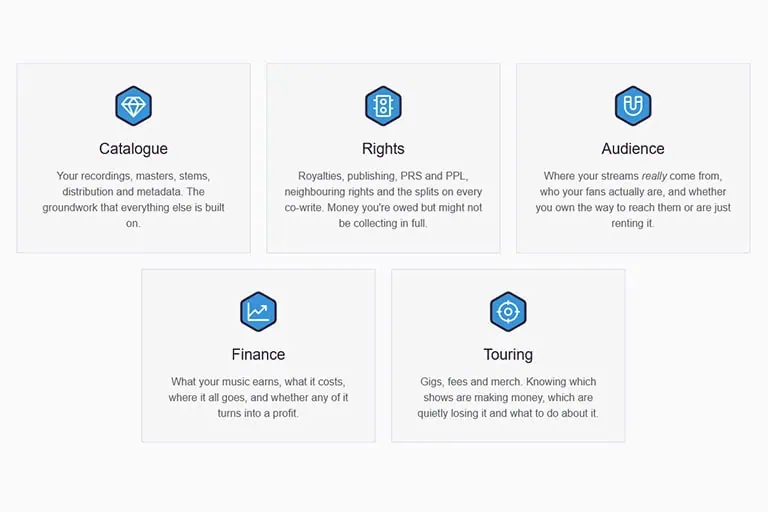
If you engage with and watch enough careers as I have up close, you quickly learn the same five areas that decide who survives this business and who stalls. Your Catalogue is the recordings themselves; plus, all the unglamorous data nobody wants to touch (except geeks like me). Rights are where those recordings turn into money you can collect. Then there’s Audience, the people who show up and keep showing up, and Finance, the plain sum of what comes in against what goes out. Touring is the live side, and whether it pays once the costs are in. Catalogue, Rights, Audience, Finance, Touring. Or, CRAFT, as it occurred to me one day.
It can be tempting to treat those as five separate jobs to tick off one at a time. In practice they lean on each other in real time, and any weak one will quietly drain and cascade onto the rest.
Errors can cascade quite dramatically as well. Get your Catalogue data wrong, a misspelt name, a missing split, no ISRC on the track, and the Rights money those plays earn can’t find you. The Ivors Academy reckons poor or missing data leaves around £500m a year of song royalties globally unallocated. That’s £500 million stuck in a pot nobody can match to the right people. A Catalogue slip shows up as a Rights hole and then lands as a Finance one. One weak link, three pillars bleeding, fast. None of that is legal advice, by the way, it is just where the plumbing tends to burst in reality.
The live side works the same way. Touring will only ever add up if there are people in the town who already know you. So, this is an Audience question long before it is ever a booking one. And, the venues themselves are struggling. In 2024, Music Venue Trust reported 43.8 per cent of grassroots venues ran at a loss, so the old cushion that let you play to a thin crowd and eat the loss is fading.
A time cost runs as an undercurrent to all of this too. The Oxford Internet Institute found 69 per cent of musicians now spend more time promoting themselves than they used to. That is Audience work quietly eating away the hours that used to go on the songs themselves. So, in reality you starve the Catalogue to feed the Audience.
This has been happening for a long time, so I stopped treating these as five separate topics and started seeing one connected system, where pulling on any thread quickly unravels the rest.
Finance is usually where it bites first, which is exactly why it fools people the most. The money is short, so the money is what you go after first. You put out another release and take whatever gigs you can get, waiting for the numbers to add up. But the shortfall is very rarely where the real issue is. The block sits upstream, in a pillar you are not even looking at, the metadata quietly leaking your royalties, or an audience too thin to make the shows pay. Chase the shortfall and you grind yourself into the ground fixing the wrong thing. Why? Because you aren’t an expert in everything and, you shouldn’t have to be.
You are almost certainly doing most of CRAFT already. The trouble is almost never that an artist is sitting still. They are working flat out, more than likely just in the wrong order, with no clear read on which of the five is actually holding them back. Work out which one that is, and everything you do afterwards pulls the same way.
Where CRAFT Came From, and Why I Built It
CRAFT came through years of managing artists, my experiences in all aspects of the music industry. And a fair bit of studying the business formally. The lessons that stuck with me the most came from watching good people drown in the same handful of places, over and over, until the pattern was impossible to miss. The quality of the music was very rarely the issue.
What also convinced me it was more than my own experience talking was how much the outside evidence agreed. A US data firm, a UK trade body, Oxford academics surveying five countries, a songwriters’ academy, and the people counting the venues going under in real time. None of them seemingly connected on the surface or working together, spread right across different years, all sketching the same picture. When findings that old and that scattered still line up in 2026, you are not looking at a fad. You are looking at how the music business now works.
Do the CRAFT ‘work’ and you’ll build the precise things a manager looks for before taking anyone on. An audience that turns up, critically and, most obviously. Beyond that, the whole engine underneath a career, running well enough that someone could step in and add to it. Those are also the things you need to survive whether a manager ever turns up or not. Now and then the music alone is so good it drags a manager in regardless. It does still happen, but it should never be the plan.
The CRAFT
That is the whole reason I built the CRAFT scorecard. It’s free, it takes a few minutes, and it scores you across all five areas so you can see which one is quietly costing you the most right now. You do it, you get your results, and what you do next is entirely your music business.
Some of you will come out of it and realise the manager conversation is closer than you thought. Others will find there is a year of groundwork that needs to be done, which is a far more useful thing to know than a polite no or a more likely ghosting from someone you were hoping would save you.
Either way, you stop guessing, and that’s the point. This doesn’t have to be a guessing game, so, remove the uncertainty. You will know which part of the thing to fix before you ever go looking for anyone to help you run it. The ones who eventually get the yes are nearly always the ones who have sorted all of this out first.
Have a go: the CRAFT scorecard.


